
How to Choose the Right Forklift Battery in 2026?

Choosing the right Forklift Battery in 2026 starts with the work, not the sales brochure. A truck moving light loads for one shift has different needs from one running multiple shifts in a cold warehouse. Before comparing prices, record operating hours, typical load weights, break times, and available charging periods. Check the forklift’s battery dimensions, required voltage, and minimum counterweight. A mismatch can affect fit, performance, or safe operation. Small details matter.

Battery expert Isidor Buchmann has written extensively about matching batteries to their applications. A practical buying principle, adapted from that guidance, is: “Choose the battery for the work pattern, not the brochure.” Compare lead-acid and lithium-ion options against real operating conditions, including charging access, maintenance capacity, and expected service life. Ask suppliers to document charger compatibility and explain warranty limits. Then compare total ownership costs, not just the initial price. That calculation may include energy, maintenance, downtime, and replacement planning.

There is no universal winner. A lower purchase price can look attractive, until charging pauses disrupt a busy shift. A newer chemistry may reduce routine maintenance, but only if the site has suitable equipment and trained support. That part is easy to overlook. This guide examines the questions buyers should ask before choosing: what the truck requires, how the battery will be used, and which trade-offs the operation can genuinely support. Measure twice. Then decide.
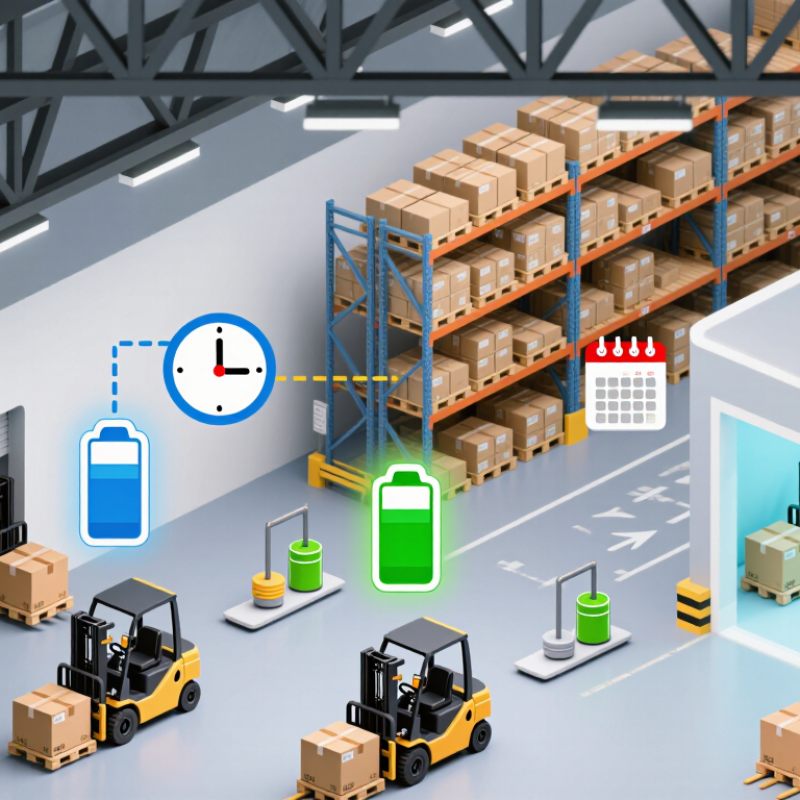
How to Choose the Right Forklift Battery in 2026?

Assess Your Forklift’s Battery Requirements and Workload

How to Choose the Right Forklift Battery in 2026?

Assess Your Forklift’s Battery Requirements and Workload

Start with the forklift’s data plate and operating manual. Confirm the required voltage, approved battery dimensions, and maximum battery weight. These are equipment limits, not preferences. A battery that fits the compartment but falls below the required weight can affect safe operation. Measure the compartment, too; small clearance differences can complicate installation.

Next, map a typical workday. Record operating hours, lifting intensity, breaks, and charging opportunities. A truck moving light loads across one shift has different needs from one lifting heavy pallets in a busy, multi-shift warehouse. Note the actual downtime, not just the scheduled break. That changes everything. Cold areas, dusty floors, and long travel distances can also influence usable runtime.

Compare those observations with battery capacity and the charging setup recommended for the truck. Check whether charging can happen during breaks or only after a shift, and confirm that the site has suitable electrical access and a designated charging area. Include routine checks and service needs in your comparison. I’ve seen workload estimates miss brief, frequent lifts; those small tasks add up. A spreadsheet helps, but it can still understate peak demand. Review your figures with a qualified battery or forklift technician before choosing.

Check Battery Voltage, Size, and Equipment Compatibility

Choosing a forklift battery starts with the equipment nameplate, not the battery listing. Confirm the required nominal voltage, such as 24, 36, or 48 volts, and check the manual if the plate is worn or unclear. A voltage mismatch can cause poor performance or damage electrical components. Check the charger rating too; a battery and charger must be compatible. Small details matter.

Next, measure the battery compartment: length, width, and available height. Allow room for cables and safe removal, and compare terminal positions with the forklift’s connectors. A battery that fits on paper may still press against a cable or leave too little clearance. Measure twice. Also check the required battery weight. Some forklifts depend on battery mass for counterbalance, so a lighter replacement may affect stability and safe operation.

Battery chemistry can change charging needs, service routines, and operating behavior. Confirm that the forklift and its charging system support the chemistry you plan to use. If specifications conflict, pause and ask a qualified service technician to verify them. Guessing from an old battery label is tempting, but labels can be incomplete or hard to read. Even a careful measurement can miss a protruding connector. Compare the full specifications before ordering.

Compare Battery Chemistries for Performance and Maintenance

How to Choose the Right Forklift Battery in 2026?
Compare Battery Chemistries for Performance and Maintenance

Battery chemistry affects charging time, upkeep, and how reliably a forklift completes each shift. Lead-acid batteries are often a practical fit for predictable, single-shift work. They need watering, cleaning, and scheduled charging, plus time to cool before reuse. Lithium-ion batteries can support opportunity charging during breaks and generally require less routine maintenance. Their higher purchase price may be offset by reduced downtime, but only when the work pattern suits them. Details matter.

Tips: Map shifts, breaks, and charging access before choosing. Check the battery’s weight and dimensions against the truck’s specifications. In cold storage, ask how low temperatures affect charging and usable capacity. A quick price comparison can miss the real costs.

Start with the actual duty cycle: loads, travel distance, aisle conditions, and peak hours. A battery that performs well on paper may struggle through repeated heavy lifts. Compare expected service life, charging needs, and available support, not just purchase price. Also confirm that charging equipment is compatible and that staff can follow the required care routine. The answer may not be the newest chemistry. Recheck your assumptions after tracking a few weeks of operation; real shift data can reveal needs that a sales estimate overlooks.

How to Choose the Right Forklift Battery in 2026? — Compare Battery Chemistries for Performance and Maintenance

Comparison Factor Flooded Lead-Acid Lithium-Ion (LFP) Lithium-Ion (NMC)
Typical fit Established option for single-shift or planned, predictable operations with time available for charging and battery changes. Often suited to multi-shift work, opportunity charging, and operations seeking reduced routine battery maintenance. Can suit applications where compact size and high energy density are priorities; confirm that the pack is designed and approved for the truck.
Usable energy and discharge Capacity is commonly rated at a specified discharge rate. Regular deep discharge can shorten service life; follow the battery maker’s discharge limits. Generally supports a greater usable share of rated capacity than lead-acid, subject to the battery management system’s limits. Also offers high usable energy in a compact pack, with operating limits controlled by the battery management system.
Charging pattern A full charge commonly takes about 8 hours, followed by a cooling period before use. Opportunity charging is generally not recommended unless the battery and charging system specifically allow it. Often charges in roughly 1–3 hours, depending on pack capacity, charger output, state of charge, and temperature. Many systems are designed for opportunity charging. Charge time depends on pack and charger specifications. Opportunity charging is possible only when supported by the specific battery system.
Typical cycle-life range About 1,000–1,500 cycles is a commonly cited range under appropriate operating and maintenance conditions. Often approximately 2,000–4,000 or more cycles, depending on cell design, depth of discharge, temperature, and charging practices. Cycle life varies substantially by cell design and operating conditions; use the supplier’s tested cycle-life data for the intended duty cycle.
Round-trip energy efficiency Typically lower than lithium-ion; approximately 70–85% is a representative range, depending on the battery and operating conditions. Typically high; approximately 90–95% is a representative range for many lithium-ion systems. Typically high, though actual efficiency depends on cell chemistry, pack design, temperature, and charge rate.
Routine maintenance Requires regular electrolyte-level checks and watering with suitable water, cleaning, and periodic equalization charging when specified. Does not require watering or routine equalization. Keep connections and the pack clean, and follow inspection and software or diagnostic guidance. Does not require watering. Follow the pack’s inspection, diagnostic, and battery-management-system requirements.
Charging-area considerations Charging can produce hydrogen gas. Use a properly ventilated charging area and follow applicable safety procedures for acid handling and charging. Does not produce hydrogen during normal charging, but still requires the specified charger, electrical protection, and safe operating procedures. Does not produce hydrogen during normal charging. Use the specified charging equipment and follow the pack’s thermal and electrical safety instructions.
Initial cost and operating costs Usually has a lower purchase price. Watering, charging time, battery changes, ventilation, and maintenance can add operating costs. Usually has a higher purchase price. Lower routine maintenance and opportunity charging may reduce labor and spare-battery needs in suitable operations. Usually has a higher purchase price. Potential space and weight advantages should be weighed against system cost and application requirements.
Key checks before purchase Confirm voltage, capacity, battery-compartment fit, watering access, ventilation, charger compatibility, and whether a spare battery is needed. Confirm truck and charger compatibility, pack dimensions and weight, charge-rate limits, temperature limits, warranty terms, and service support. Confirm that the chemistry and pack are approved for the truck, and verify charge limits, thermal protections, dimensions, weight, warranty, and service support.
Best choice when Budget is a priority and the operation can accommodate scheduled charging, maintenance, and battery changes. High utilization, multiple shifts, reduced routine maintenance, or opportunity charging are important goals. Space or energy density is especially important and the specific pack is validated for the forklift’s duty cycle.

Note: Figures are representative industry ranges, not guarantees. Actual performance varies with battery design, capacity, charger, temperature, duty cycle, discharge depth, and maintenance. Check the forklift and battery specifications and applicable safety requirements before selecting a system.

Match Battery Capacity to Shift Length and Charging Access

How to Choose the Right Forklift Battery in 2026?

Match Battery Capacity to Shift Length and Charging Access

Choosing a forklift battery starts with the work pattern, not just the truck’s rating. Record operating hours, loads, travel distance, and lift frequency across a typical shift. A truck moving heavy pallets up a ramp uses energy differently from one making short warehouse trips. Compare that real demand with the battery’s usable capacity, not only its advertised capacity. That matters. Cold conditions and aging can also reduce available runtime.

Tips: Check energy-use records from several busy days. Include breaks, shift overlap, and time spent waiting. A neat estimate can still miss an unusually demanding day.

For one shift with a long overnight charging window, a correctly sized battery may be sufficient. For multiple shifts, limited charging access can make spare batteries or planned charging necessary. Confirm that the battery and charger are compatible, and check whether the work schedule allows safe, practical charging. Place charging equipment near the operating area when possible; a distant station can quietly eat into break time. Leave a sensible capacity reserve. The spreadsheet may still be wrong, so reassess after a week of actual use.

Evaluate Total Cost, Safety, and Battery Life in 2026

A forklift battery should be priced as a shift asset, not just a purchase. Compare the battery, charger, installation, electricity, maintenance, downtime, and replacement costs across its expected service life. BloombergNEF’s 2024 Battery Price Survey reported an average lithium-ion pack price of $115 per kilowatt-hour, 20% below 2023. That is a market benchmark, not a forklift-ready quote; installation and duty cycle change the real cost. A neat spreadsheet can still mislead.

Safety deserves its own evaluation. OSHA estimates that forklifts cause about 85 fatalities and 34,900 serious injuries each year in the United States; these figures cover forklift incidents generally, not battery incidents alone. OSHA standard 1910.178(g) sets requirements for battery charging and changing areas. Check ventilation, spill controls where relevant, secure battery restraints, and clear charging procedures. Small details matter.

Battery life depends on chemistry, charging habits, temperature, and workload. Ask suppliers for warranted capacity retention and cycle-life test conditions, then compare them with your actual shifts. Track usable energy, charging time, and downtime—not just years of service. A battery that looks cheaper may cost more if it cannot cover a full shift. Review the figures after a real operating trial; forecasts are imperfect.

X
Solinso-gdpr
Privacy Overview

This website uses cookies so that we can provide you with the best user experience possible. Cookie information is stored in your browser and performs functions such as recognising you when you return to our website and helping our team to understand which sections of the website you find most interesting and useful.