How Do Solar Powered Homes Work?
Solar powered homes turn sunlight into usable household electricity through a connected set of components. Roof-mounted photovoltaic panels capture sunlight and produce direct-current electricity. An inverter converts that output into alternating current, which powers familiar devices such as a refrigerator, lights, and a washing machine. When production exceeds demand, a home may send surplus electricity to the grid or store it in a battery, depending on its equipment and utility arrangements. At night, during cloudy weather, or when demand rises, the home can draw from stored energy or the grid. The system is not a magic box. Its output changes with the season, roof direction, shade, temperature, and household habits.
Understanding how solar powered homes work means following both the electricity and the decisions behind the system. A monitoring app may show midday production, while a battery’s charge level reveals how much energy remains for evening use. Yet those figures need context: panel ratings do not guarantee a specific bill reduction, and battery capacity is not always the same as usable capacity. A careful assessment considers recent utility bills, roof condition, local sunlight, backup needs, and connection requirements. Qualified installers can evaluate wiring and equipment compatibility; homeowners should compare documented estimates rather than rely on one sales claim. Small details matter. Even a shaded vent can affect output. Real results may differ from forecasts, and that deserves honest attention. This guide explains the basic flow, common system choices, and tradeoffs, helping readers ask better questions before making an investment.
How Solar Panels Capture Sunlight
When sunlight reaches a rooftop panel, photons enter its semiconductor cells, usually made from silicon. Their energy frees electrons, and the cell’s internal electric field guides those charges into a direct-current flow. That is the basic conversion. Metal contacts collect the current, while wiring carries it toward an inverter, which changes it into alternating current for household circuits.
A panel does not turn every photon into electricity. Some light reflects away, and some energy becomes heat. NREL’s Best Research-Cell Efficiency Chart places leading silicon laboratory cells near 27% efficiency, but that is a research benchmark, not a promise for a home roof. Real output varies with panel temperature, shading, roof angle, and sunlight. A small chimney shadow can matter. NREL’s PVWatts documentation uses a default system-loss assumption of 14%, covering factors such as wiring, soiling, and inverter losses; actual homes differ. It is a useful model, not a measurement of any particular house. I would pay close attention to shade at different times of day. One quick roof inspection can miss it.
How Solar Panels Capture Sunlight
Sunlight reaching a solar panel varies through the day, typically peaking near solar noon. The values below are representative clear-sky global horizontal irradiance, measured in watts per square metre (W/m²), not measurements from a specific location. Photovoltaic cells convert some of this sunlight into direct-current electricity; an inverter can convert it into alternating current for household use.
How Inverters Convert Solar Power for Home Use
How Do Solar Powered Homes Work?
How Inverters Convert Solar Power for Home Use
Solar panels generate direct current (DC), while household circuits use alternating current (AC). An inverter converts the electricity and adjusts panel operation as sunlight changes. NREL’s PVWatts documentation uses 96% as its default inverter-efficiency assumption. That is a modeling value, not a guarantee for every home. Heat, shading, wiring losses, and operating load affect real output.
On a sunny afternoon, a string inverter can convert DC from several roof panels before sending AC to the electrical panel. Microinverters convert power at individual panels, which can be useful when roof sections receive different amounts of sunlight. A hybrid inverter can also manage electricity flowing to or from a battery. Small details matter. Ask about efficiency across different loads, not only the peak figure. The U.S. Department of Energy explains that inverters make solar electricity usable in home circuits and help connect systems to the grid. Standard grid-tied systems generally shut off during a grid outage unless configured with suitable backup equipment. That can surprise homeowners. NREL’s 96% assumption helps with estimates, but a real system is less tidy than a spreadsheet.
How Electricity Flows Through a Solar-Powered Home
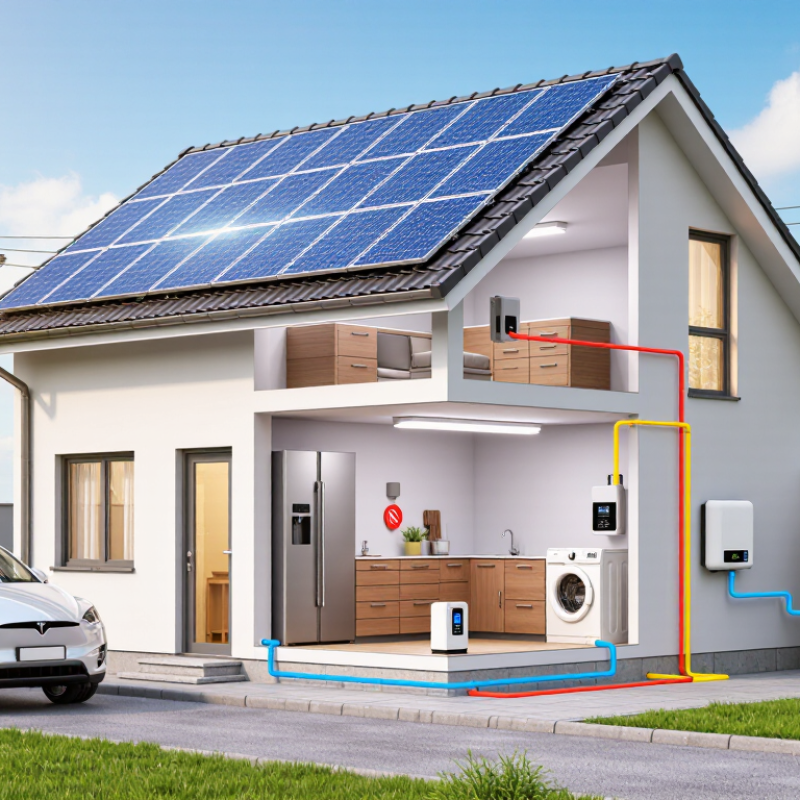
Sunlight hits photovoltaic cells on the roof, which produce direct-current (DC) electricity. A grid-connected inverter changes it into alternating current (AC), the form used by household circuits. From there, electricity enters the home’s main electrical panel and can power a refrigerator, lights, or laptop. Clouds pass. Production rises and falls with sun angle, shade, roof direction, and temperature, so the panels do not provide a constant output.
When the home uses less electricity than the panels produce, the extra power may flow through a meter to the grid. If a battery is installed, the system can store some surplus energy for later use. At night, electricity comes from stored energy or the grid, depending on the system’s configuration.
A standard grid-tied system usually shuts off during a grid outage unless it includes suitable backup equipment. That safeguard protects utility workers, but it also means sunny panels alone may not keep the house running. The wiring diagram looks tidy; a real roof is less so. Chimney shade can affect production, and monitoring readings may help reveal changes without explaining every fault. Have a qualified professional assess unusual readings rather than opening energized equipment.
How Batteries Store Excess Solar Energy
During daylight, rooftop panels produce direct-current electricity from sunlight. A home uses some of it immediately, while extra power can charge a battery. A charge controller and inverter manage the flow and convert electricity into a form household appliances can use. Many home systems use lithium-ion batteries, though storage capacity and performance vary. Not instantly. Charging and discharging both involve small energy losses, so stored electricity is not a perfect copy of the power generated.
After sunset, the battery can supply lights, a refrigerator, or other selected circuits. An inverter changes the battery’s direct current into household alternating current. Capacity, measured in kilowatt-hours, affects how long those devices can run; power rating determines how many can run at once. On a cloudy day, panels may not fully recharge the battery, and a reserve setting can keep some energy available for outages. That reserve also means less stored power is used during an ordinary evening. A useful check is to compare the battery’s usable capacity with overnight consumption, rather than relying on its advertised total alone. Real monitoring can reveal surprises: a refrigerator cycling often, for example, may use more energy than its quiet hum suggests.
How Do Solar Powered Homes Work? — How Batteries Store Excess Solar Energy
| System stage |
What happens |
Illustrative value or detail |
| Solar panels |
Photovoltaic cells convert sunlight into direct-current (DC) electricity. |
A 5 kW array receiving 5 peak sun hours with an assumed 80% overall production factor would generate about 20 kWh in a day: 5 kW × 5 hours × 0.80. |
| Inverter |
A grid-connected inverter converts the panels’ DC electricity into alternating-current (AC) electricity for household use. A hybrid inverter can also manage battery charging and discharging. |
Inverter conversion efficiency is commonly in the mid-to-high 90% range; actual performance depends on equipment, load, temperature, and operating conditions. |
| Home loads |
Appliances use solar electricity as it is generated. Solar production is used on site before additional energy is sent to a battery or the grid, subject to system controls. |
In the example below, the home uses 12 kWh of solar electricity directly during the day. |
| Excess solar energy |
When solar production exceeds household demand, the system can send surplus electricity to the battery, export it to the grid, or do both. |
In the example, 8 kWh of surplus electricity is directed to the battery during the day. |
| Battery charging |
The battery stores energy chemically. Its battery-management system monitors operating conditions and helps keep charging within safe limits. |
An illustrative 10 kWh nominal battery configured for 90% usable capacity has about 9 kWh available for cycling. Usable capacity varies by model and settings. |
| Battery discharge |
When solar production falls, stored energy is converted back into electricity for household loads. Some energy is lost during charging and discharging. |
At an assumed 90% round-trip efficiency, 8 kWh sent into storage would deliver about 7.2 kWh later. Actual efficiency varies by battery, inverter, and operating conditions. |
| Nighttime electricity |
The home can use battery energy after sunset. If demand exceeds the battery’s available output, the remaining electricity may come from the grid. |
For example, if nighttime loads require 10 kWh, 7.2 kWh from the battery would leave about 2.8 kWh to be supplied by the grid, assuming the grid is available. |
| Grid connection |
A grid-connected home can import electricity when solar and battery output are insufficient and may export surplus electricity when permitted by local rules and system settings. |
Export compensation and grid-interconnection rules vary by location and utility. A standard grid-connected solar system may shut down during a grid outage unless it has suitable backup equipment. |
Example assumptions: The energy figures are illustrative, not a performance guarantee. Solar output changes with sunlight, weather, shading, orientation, and system condition; battery capacity and efficiency also vary.
How Grid Connections Support Solar-Powered Homes
A grid connection lets a solar-powered home share electricity with the wider network. During sunny hours, panels supply household circuits first; excess power can flow through an inverter and meter to the grid. After sunset, the home can draw electricity back. Export payments and credits depend on local utility rules, so exported power does not always earn the same rate the household pays to import it. The meter records the exchange. Not automatically.
Grid connection also affects outages. Standard grid-tied inverters usually shut down when the grid fails, protecting utility crews from unexpected backfeed. A battery and suitable isolation equipment can keep selected circuits running, but not every solar home has this setup. It can feel counterintuitive: bright panels may still go quiet during a blackout. The International Energy Agency’s 2023 report on electricity grids estimated that more than 1,500 gigawatts of advanced-stage renewable projects were waiting for grid connections worldwide—about five times the solar and wind capacity added in 2022. That queue shows why a rooftop system’s value depends partly on local grid capacity and interconnection processes. A connection is useful, but it is not a storage system. There is room to plan better.