

The article below was written about the financial feasibility of solar installations in the Netherlands. Only the points concerning the feed-in tariff are specific to the Dutch situation, the remainder of the article is generally applicable.
In a world where sustainable energy solutions are more crucial than ever, Solinso panels offer the perfect triad of energy efficiency, a cost-effective way to transition to renewable energy, and a beautiful expression of your roof. With the current changes in the net metering (salderingsregeling), now is the time to consider the long-term benefits of choosing high-efficiency solar panels like Solinso.
Net metering with renewable energy (Netherlands)
The current net metering system was officially introduced in the Netherlands in 2004. Under this system consumers are automatically allowed to supply any excess electricity produced by their solar installation to the electrical grid and receive an equal amount of electricity back from the grid at a later time.
Example net metering
A household produces 3000 kWh of electricity per year using solar panels, typically 900 kWh (30%) of this electricity will be used by the household itself, the remaining 2100 kWh is supplied to the electrical grid and credited to the household. The household consumes 5000 kWh of electricity per year, 900 kWh of this electricity is supplied directly by the solar system. The remaining 4100 kWh is supplied by the electrical grid. Because the household has 2100 kWh of credits, only the remaining 2000 kWh of electricity needs to be paid for to the electrical company.

From 2027 onwards
The net metering scheme will end on the 1st of Januari 2027. However electrical companies are by law still obligated to:
-
Accept households supplying their surplus solar power to the electrical grid.
-
Pay households a minimum of about 10% of market rate for the power supplied to the grid.
Setting the price at 10% of the market rate may seem low however it can be explained. Only about 20% of the market rate for electricity is determined by the cost of producing the electricity (in a solar farm or gas turbine plant for example), the other 80% of electricity’s price is determined by transportation, distribution and taxes. Supplying electricity from a solar system to the electrical grid means that the electrical company still needs to take care of the transportation and distribution which is the more expensive part.
A realistic price paid to consumers for supplying electricity to the electrical grid in 2027 onwards is (currently) about 5 ct/kWh (20% of market rate). Some electrical companies advertise (much) higher rates but also have a separate fixed feed-in costs (terugleverkosten/terugleverboete) which ultimately means the rate is still effectively around 5 ct/kWh.
Example feed-in costs (fixed rate contract)
A household has a surplus of 3000 kWh of electricity produced by their solar installation
- Company A will buy electricity from the homeowner for 5 ct/kWh. The company will then pay the household 3000 x €0.05 = €150.
- Company B will buy electricity from consumers for 15 ct/kWh however there is a feed-in cost of €300,- per year. The company will credit the household 3000 x €0.15 = €450 but also subtract €300,- for the feed in cost. Resulting in a total of €450 – €300 = €150.
The most important takeaway from this is that in 2027 it will not be financially interesting for consumers to sell their solar electricity to electrical companies (consumers will still be paid for their electricity however about 20% of the 2025 rate). However using the produced solar electricity within the household saves the consumer from buying the electricity at the market rate, saving them from buying electricity for 100% of the price. In the coming years it will become more important to maximise the self-consumption of produced electricity. The goal is to match the consumption of electricity to the production of electricity, this can be achieved by (for example):
- Charging electric vehicles during high production times
- Turning on dishwashers, washing machines or dryers (using a timer for example) during high production times
- Storing the produced electricity in a home battery system for later use
- Programming a heat pump to do most of the heating when solar energy production is high
Comparison: Solinso solar roof vs traditional solar
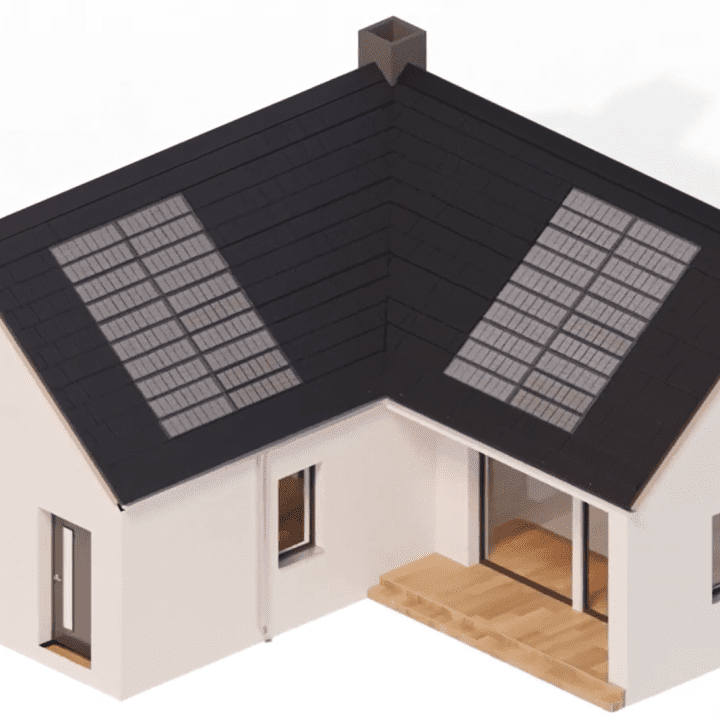
In this section we will be comparing a Solinso solar roof system to a traditional solar system, both systems are about 20m2 in size and have an installed power of 4.4 kWp. It is important to mention that installing a solar roof saves the homeowner from buying 20 m2 of traditional tiled roof and then having solar panels installed on top of this roof, these savings are included in the example below. The estimated cost of both systems is as follows:
Example: Solinso solar roof
- €8400 for materials: 38 solar roof modules, inverter, assembly materials
- €750 for installing inverter (incl. AC work)
- €400 for installing solar roof
- -€1500 saving normal rooftiles and installing
Total: €8050,-
Example: traditional solar system
- €2750 for materials: 10 solar modules, inverter, assembly materials
- €750 for installing inverter (incl. AC work)
- €1500 for installing solar panels
Total: €5000,-
Payback period
In the “From 2027 onwards” section of this article, we stated that using the electricity produced by the solar system will be the most important factor in the financial feasibility of the system. Using the estimated costs of the two solar systems above we can calculate approximate payback periods for the two systems (assuming 0.25% degradation and the current price of €0.32 / kWh), results in the table below .
Example: payback periods and self-consumption
| Self consumption (%) | Type | Payback Period |
| 30% | Solinso solar roof | 14 years |
| 50% | Solinso solar roof | 9 years |
| 70% | Solinso solar roof | 7 years |
| 30% | Traditional PV | 8 years |
| 50% | Traditional PV | 6 years |
| 70% | Traditional PV | 4 years |
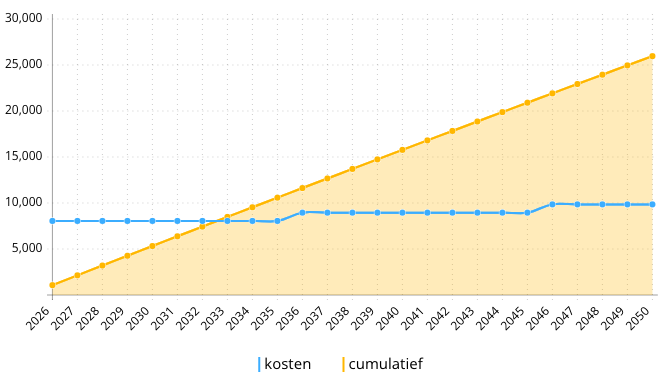
In the above table it becomes clear that increasing the self-consumption is essential in realising a short payback period. The Solinso solar roof is about 50% more expensive than the traditional solar panels and this is also reflected in the payback period being also about 50% longer. However by increasing the self-consumption of the produced electricity it is possible to reduce the payback period by half or more! Ultimately the choice between a traditional solar system and the aesthetic Solinso solar system is a personal one. Besides from having slightly longer payback period the integrated solar system will add a significant amount of value to the home.