

Discarded solar panels are a growing problem for the circular economy, but they also offer a huge opportunity. Solar2Cycle is tackling this challenge and extracting valuable raw materials from solar panels, such as silicon, copper and aluminium. By reusing these materials, the company is contributing to a circular and sustainable future for solar energy — and demonstrating that recycling can truly be forward-looking.
Research and innovation as foundation
What began as an issue within a family recycling business grew into an ambitious and independent initiative by Gijs ten Brinke: Solar2Cycle. The company is independent and focuses entirely on high-quality PV recycling. Solar2Cycle is actively recycling solar panels from early 2025, and the first machine line is now operational.
Solar2Cycle combines practical experience with technical innovation. In collaboration with colleges, universities and machine manufacturers, the company has developed a process that recovers up to 99.8 per cent of the raw materials from solar panels. This means that materials that were previously lost can now be put to valuable use again.
New technologies for plastic and glass
Solinso-panels have plastic frames instead of aluminium. Solar2Cycle is investigating how the sealant between the frame and the panel can be removed so that the panel can be fully recycled.
A particular challenge is glass from China, which contains antimony to make it stronger and more brittle. This allows glass to achieve higher purity and strength. Solar2Cycle works with glass recycling partners to process the antimony safely and make the glass suitable for reuse within European standards.
Environmental benefits & impact
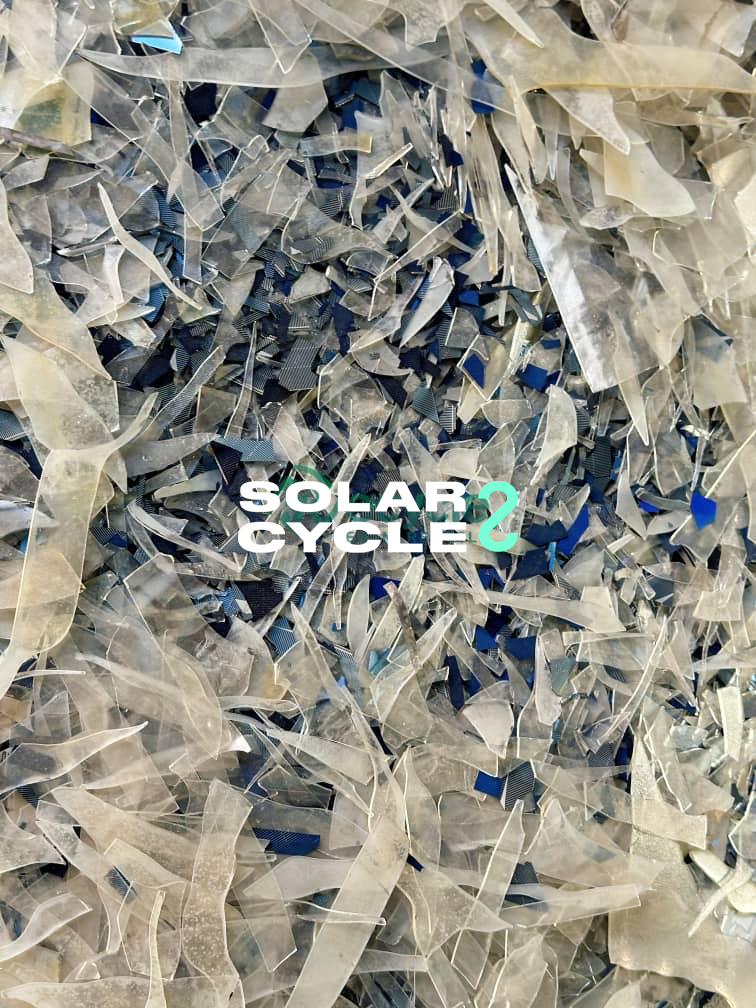
Each recycled solar panel saves approximately 58 kilograms of CO₂. Aluminium, for example, is returned to the German automotive industry, and other materials find their way into a variety of sectors. The silicon cells from recycled solar panels are also given a second life. Raw materials for solar cells require an extremely high purity of 99.999999%, while recycled silicon currently achieves a purity of 99.95%. This is not yet sufficient to make fully functional solar panels again, but the material is of high quality for other applications. Thanks to this purity, it is ideal for the chip industry and other semiconductor applications, such as sensors and electronic components. In this way, part of the solar cell is still put to good use in high-tech sectors, which means that Solar2Cycle not only supports the circular economy, but also contributes to innovation in other industries. It shows that recycling can be more than just reuse in the same sector: it opens doors to new technological applications and future-oriented solutions.
Recycling one solar panel saves approximately
58
kg CO₂

Growing into a fully-fledged factory
The actual recycling activities only started at the beginning of this year, and Solar2Cycle has already processed approximately 20,000 solar panels in 2025. This result immediately demonstrates the potential of the project. With a new machine line that is expected to achieve more than 94% recycling, and a growing network of partners in the Netherlands, Belgium and Germany, the company is working on scaling up its factory in Rijssen, which will eventually be able to process a large proportion of Europe’s end-of-life PV panels.
Ambition: a future of hope and circular energy
Solar2Cycle wants to show that recycling is fun, feasible and future-oriented. It does not sell machines, but gives as many panels as possible a second life. Through innovation, collaboration and careful processing, the company demonstrates that a circular PV market is within reach. For Solinso and its partners, this is an inspiring example of how sustainability and technology come together to solve today’s problems and create opportunities for tomorrow.